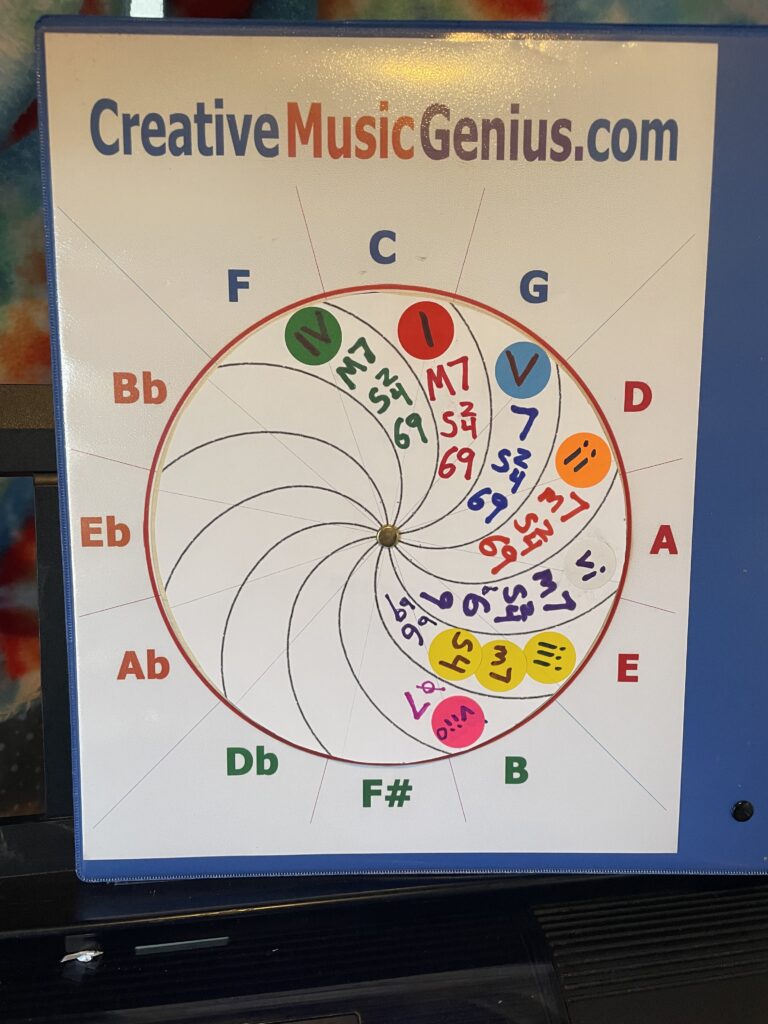
Dial up advanced chords to spice up your song or add authentic flavor.
These chords bring your songwriting and music creation skills to the next level of WOW.
Did you ever write a song and wish it was more interesting, had a a certain vibe or feel, or you just wanted to spice it up some?
The Wheel of Infinite Flavor gives you a whole variety of advanced chords that can bring your musical creations to life.
Types of Advanced Chords by Category
- M7 – Major 7th chords. These chords have and almost God like, angelic feel to them. They have a certain brightness and lightheartedness. Good for love songs or Spiritual themes.
- 7 – Dominant 7th chords. The classic blues chord. Also the V7 chord has the most powerful pull to the Root or Tonic chord.
- m7 – minor 7th. The 7th on a minor chord lightens is up. Minor chords are natural sad and somber sounding. Adding the 7th bring in a lightness of being, a smoothness that says, “Life ain’t so bad after all.
- Diminished 7th – This chord has a strong pull to the home chord or tonic. It can also be used between to chords as a passing tone. Adds movement to the chord progression.
- Sus2 chords – adds vibrancy and intensity
- Sus4 chords – Wants to resolve to the major or minor chords of the same name. Ex. Csus4 – C major. Often Sus2 and sus4 are used together.
- 6th chords – bittersweet melancholic. Often used as a passing chord between a major chord and it’s 7th. Adds dimension and depth.
- b6 chords – adds mystery, spookiness and dissonance.
- 9th chords – can be used to create a jazzy, uplifting feel. Many uses depending on context.
- b9th chords – Adds dissonance, thriller, sci-fi type vibe. Use sparingly
- 11th chords – Similar to sus4 chords with a fuller sound, as the 4 and 11 are actually the same note.
So you can hear each chord type has a corresponding feel or vibe to it. One of the best things you can do to train your ear is to play each type of chord independently.

For example play a CM7 chord. Notice how it sounds. Then try an FM7 and a DM7. Notice the similarity in the way these chords sound? Once you learn to recognize different types of chord sounds, you can call them up at will to get the feel and vibe you want in your music productions.
Please consider hitting the tip jar to help our creative genius buy a green smoothie to keep the neural pathways lit.