Hey music creators!
Ever feel like your chord progressions are a little too predictable? Want to add some unexpected twists that keep listeners hooked? Let me introduce you to your new best friend: secondary dominants!
Ready to spice up your music? Watch the full video below for a fun breakdown with audio examples!
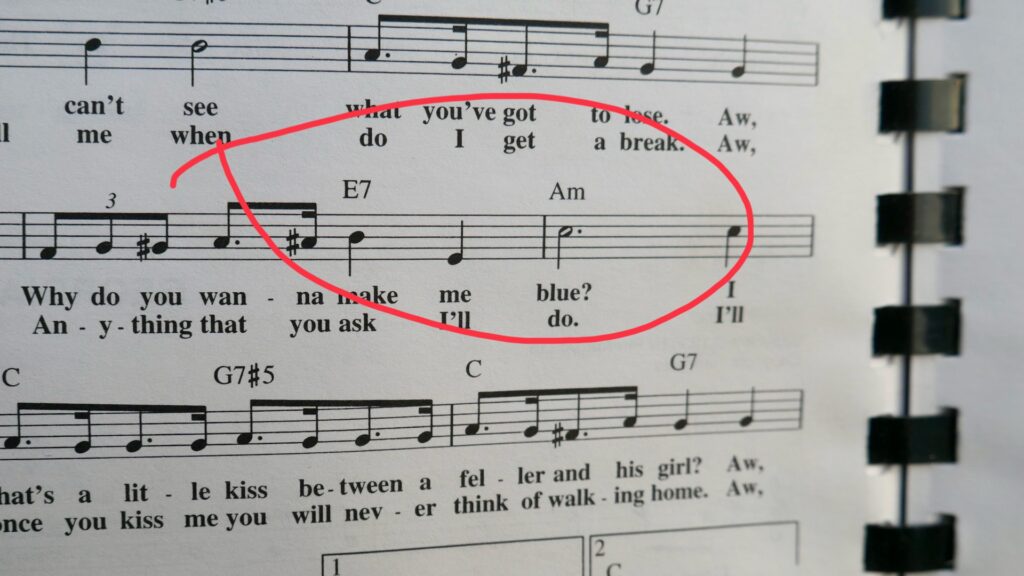
Today, we’re diving into how these spicy chords can breathe life into your music. And guess what? We’ll take a trip back to 1926 with the song “Give Me a Kiss Will Ya” to show how this timeless trick has been flavoring music for decades.
What Are Secondary Dominants?
Imagine you’re hanging out at home (your home chord, that is), and you decide to take a quick trip to your neighbor’s house. But before you do, you send a text to let them know you’re coming—that’s your secondary dominant! It’s a temporary dominant chord that points to a chord other than the tonic, creating tension and release.
Music Theory, the basics
Example Time!
In “Give Me a Kiss Will Ya,” the song starts in the key of C major. You’ve got your classic C major (home) and G7 (the dominant). But then—surprise!—it throws in an E7 before landing on A minor. That E7 isn’t in the key of C, but it leads beautifully to A minor. That’s the magic of a secondary dominant!
Another example: A7 leads into D minor. A7 doesn’t belong in C major, but it smoothly guides you to D minor. It’s like adding a little unexpected spice to your favorite dish.
How to Use Secondary Dominants in Your Own Songs
- Pick a Chord You Want to Target. Let’s say A minor.
- Look One Step Clockwise on the Circle of 5ths. That’s E.
- Make It a Dominant 7th. E7!
- Play E7 Before A Minor. Feel that smooth tension and release? That’s the magic!
Stack ‘Em Up!
Feeling bold? Try stacking secondary dominants! In the song, they use D7 → G7 → C major. That D7 leads to G7, which leads back home to C. It’s like setting up a domino effect of musical tension.
Experiment and Have Fun!
The best part about secondary dominants is how flexible they are. Throw them into your progressions and see what happens. Music is all about exploring and creating vibes that feel right to you.
“And he said: ‘Truly I tell you, unless you change and become like little children, you will never enter the kingdom of heaven.’”
Explaining Secondary Dominants to a 7-Year-Old (Fun and Simple!)
Hey there! Let’s talk about music magic! 🎵✨ Imagine you’re on a musical adventure, and you’re walking through a forest of chords. Most of the time, you’re walking on a path that feels familiar, like in the key of C major. But sometimes, you want to visit a cool new place for a moment—like a secret treehouse or a hidden cave. That’s where secondary dominants come in! They’re like magical bridges that take you to a new spot before bringing you back home.
What’s a Secondary Dominant?
A secondary dominant is a special chord that makes another chord feel like the “boss” for a little while. It’s like saying, “Hey, let’s pretend this chord is the most important one right now!” Then, after a few seconds, you go back to the real boss chord (the tonic).
How Does It Work?
- The Dominant Chord: In music, the V chord (like G major in C major) is like a superhero that always wants to bring you back home to the I chord (C major). It’s super strong and makes you feel like you’ve arrived.
- The Magic Trick: A secondary dominant is when you use a new superhero chord to point to a different chord, not the home chord. For example, if you want to make the Am chord feel special for a moment, you can use an E7 chord (the superhero for Am) to point to it.
Fun Examples in the Key of C Major
Let’s pretend we’re in the key of C major, and the notes are like a playground. Here’s how secondary dominants work:
1. Visiting the Am Treehouse:
- Normal path: C → Am (boring, right?).
- Magical path: C → E7 → Am.
- E7 is the superhero chord that says, “Hey, let’s visit the Am treehouse!”
- Then, Am feels like the boss for a moment.
2. Visiting the G Mountain:
- Normal path: C → G (yawn).
- Magical path: C → D7 → G.
- D7 is the superhero chord that says, “Let’s climb the G mountain!”
- Then, G feels like the boss for a moment.
3. Visiting the F Cave:
- Normal path: C → F (meh).
- Magical path: C → C7 → F.
- C7 is the superhero chord that says, “Let’s explore the F cave!”
- Then, F feels like the boss for a moment.
Why Are Secondary Dominants Cool?
- They Make Music Exciting: It’s like adding a surprise twist to a story!
- They Create Drama: Imagine a superhero swooping in to save the day—it’s thrilling!
- They Help You Explore: You get to visit new places in the music before coming back home.
Let’s Play a Game!
Let’s pretend you’re a composer, and you want to make your song more fun. Here’s a normal chord progression:
C → F → G → C (Home → Cave → Mountain → Home).
Now, let’s add some secondary dominants to make it magical:
C → C7 → F → D7 → G → E7 → Am → G → C.
- C7 points to F (the cave).
- D7 points to G (the mountain).
- E7 points to Am (the treehouse).
Now your song is an adventure! 🎉
Secondary dominants are like musical superheroes that take you on fun little trips to new places in your song. They make music more exciting, surprising, and colorful. So next time you hear a song, listen for those magical bridges—they might just take you on an adventure! 🎶✨