Let’s Go! Time to make some music.
Unlocking Chord Progressions with the Circle of 5ths
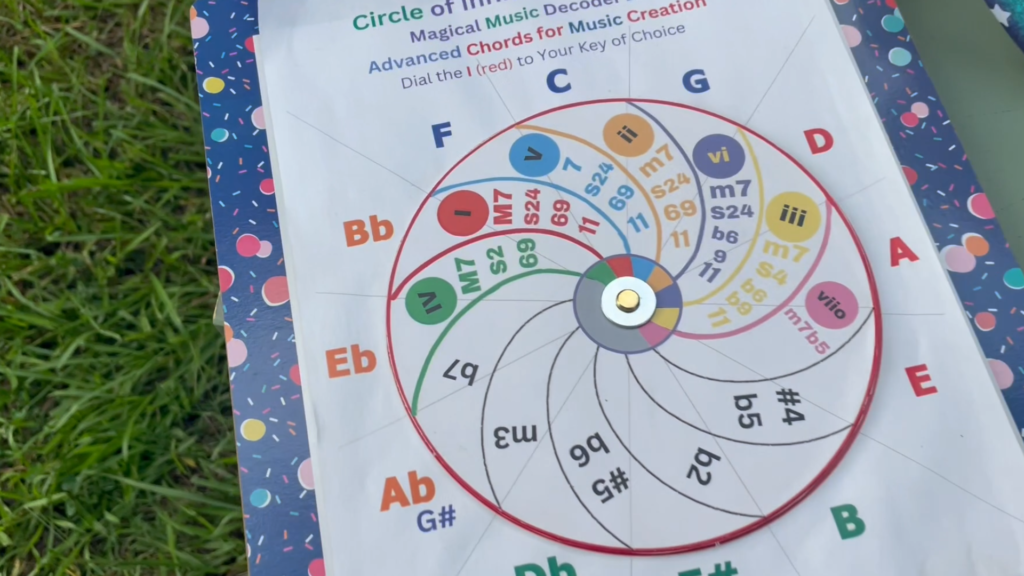
Imagine the Circle of 5ths as a musical adventure board, like a quest map in a video game. Each point on the map leads you to different chords that sound amazing together, helping you level up your music-making skills.
Join me on Patreon at the Creation Genius Level to get this ebook as one of several bonuses.
The Basics: Start Your Journey
When you’re beginning your quest, you might stick close to home—using chords that are close to your starting point, or “tonal center.” Let’s say you start on C. The chords that are closest to C on the Circle, like F and G, are like your trusty sidekicks. They’re reliable, they work well together, and they’re the foundation for many great songs.
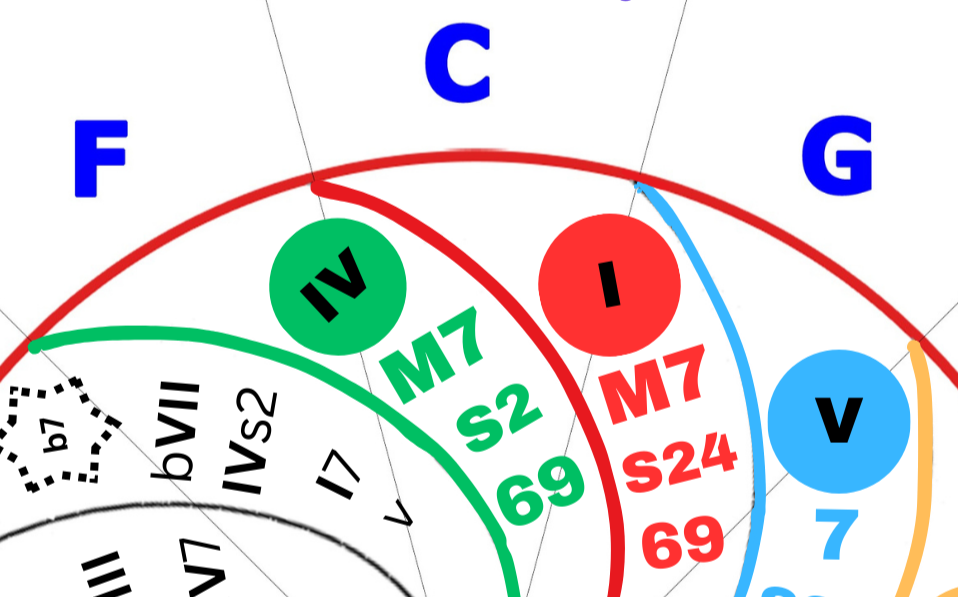
This gives you a basic chord progression: C, F, G. Simple, yet effective, like a basic move in a game that gets the job done every time.
Adding Complexity: Explore New Territory
But what if you want to venture beyond the basics? That’s when you start exploring chords that are a little further away on the Circle. For example, you might bring in an Am or Dm to add some variety to your progression. Now you’re playing something like C, Am, F, G, or C, Dm, G. These chords are still part of the same world, but they introduce new colors and emotions to your music.
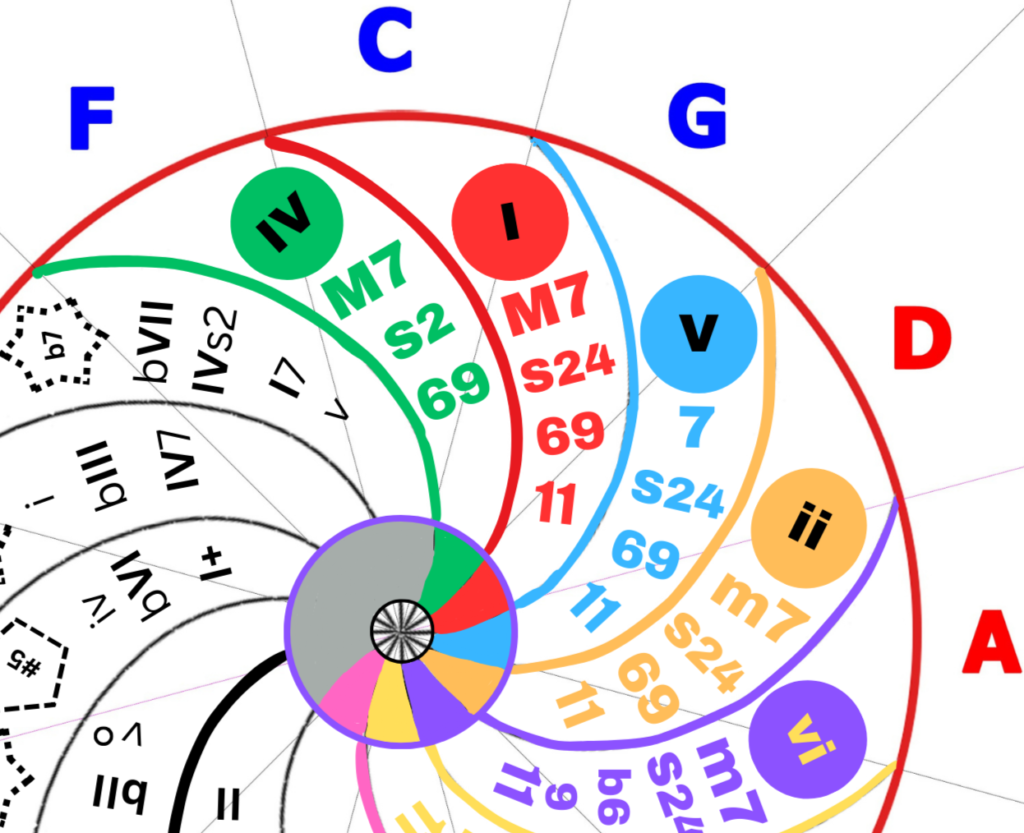

Want to get really adventurous? Throw in a Bdim for some tension or mix in an E7 as a secondary dominant (a chord that briefly makes it feel like you’re in another key). It’s like discovering a secret level in the game—unexpected but super cool.
Notice how all the chords we have used so far start out close together on the circle of 5ths and then expand to the right as we get more variety into our music.
The circle as as sort of a roadmap for music creation.
Advanced Techniques: Modulations and Secondary Dominants
Alright, you’ve mastered the basics, and you’re ready for some advanced techniques. This is where the Circle of 5ths really shines as your ultimate cheat code.
Modulations: Changing the Game
Modulating is like moving to a different area of the map—a new key. You can modulate to a key that’s close to your home base (like moving from C major to G major), which feels smooth and natural. This is called a “near modulation,” and it’s like taking a short trip to a neighboring town.
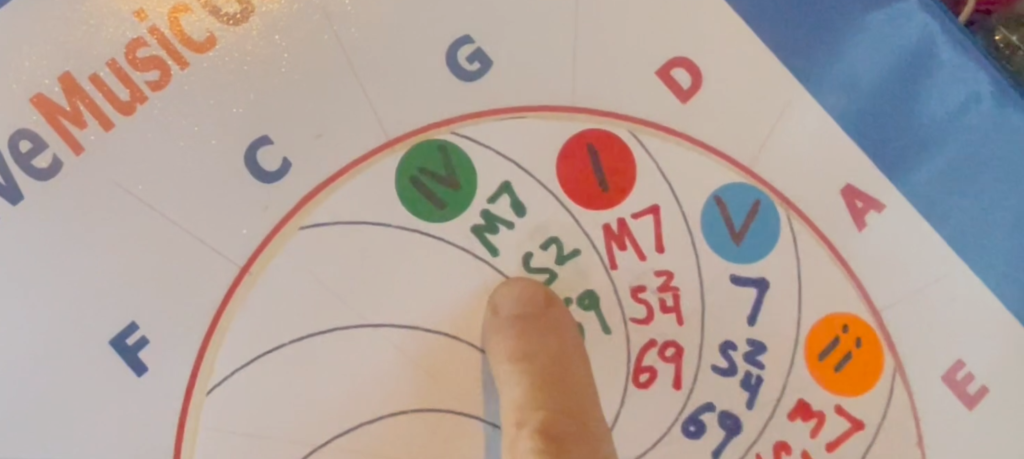
But if you’re feeling bold, you might want to jump to a key that’s far away on the Circle—like from C major to E major. This “far modulation” is like teleporting to a whole new world in your game. It’s more surprising and can really make your music stand out.
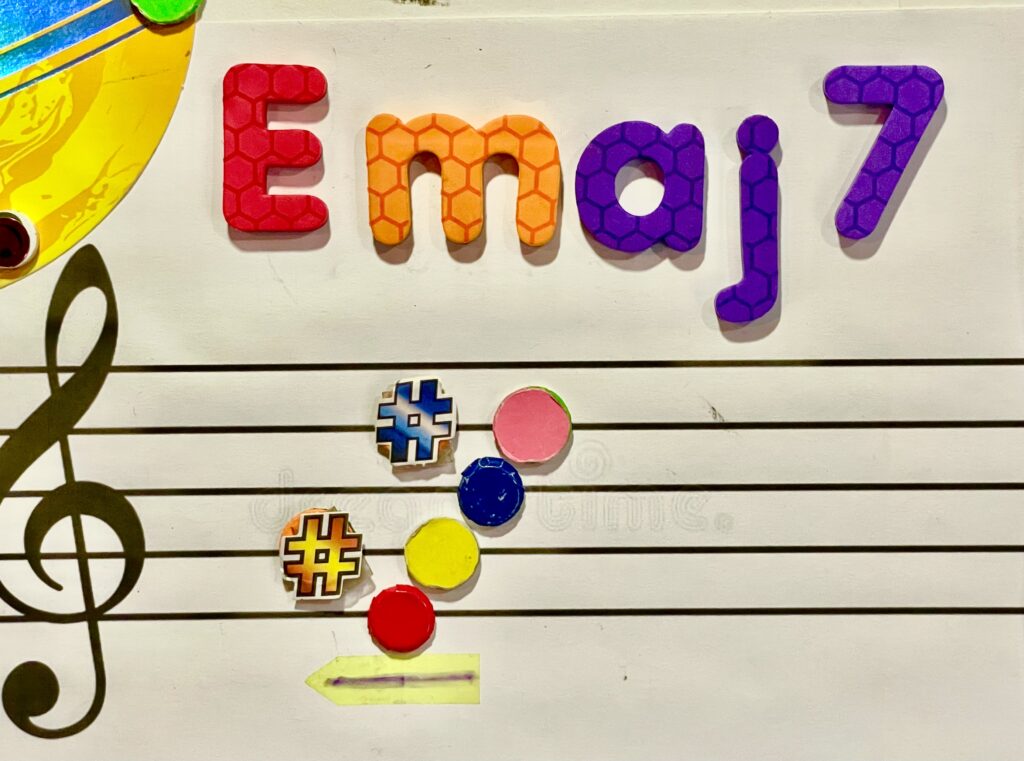
Secondary Dominants: Secret Weapons
Remember the E7 we mentioned earlier? That’s a secondary dominant. Think of it as a special power-up in your quest. Normally, E7 would be the dominant (or V chord) in the key of A major, but when you use it in the key of C major, it adds a burst of energy and a sense of forward motion. It’s like giving your music a temporary boost that keeps the listener hooked.
You can use secondary dominants to prepare for a modulation or just to add some spice to your progression. For example, you might play C, E7, Am, G. That E7 gives a hint of something different, leading smoothly into the Am.
Crafting Melodies Over Your Progression
Now that you’ve got your chord progression sorted, let’s talk about crafting melodies—the tunes that soar over your chords like a hero on their quest.
Singing Along the Path:
When you’re playing a chord like C major, your melody can start on any note that’s part of that chord (C, E, or G). These are your “safe” notes—they’ll always sound good because they fit perfectly with the chord.
But if you want your melody to stand out, you can take some risks by exploring notes that are just outside the chord. It’s like venturing off the main path in your quest to find hidden treasures. These notes create tension and excitement, making your melody more engaging.
Modulating Your Melody:
If you decide to modulate to a new key, your melody can follow suit. Let’s say you move from C major to G major. Your melody should start to focus on the notes of the G major chord (G, B, D) and the surrounding scale. This shift makes your melody feel fresh and keeps the listener intrigued, as if you’ve just unlocked a new level in your game.
Wrapping It Up
The Circle of 5ths is more than just a tool—it’s your trusty map for navigating the world of music creation. Whether you’re sticking to the basics, exploring complex chord progressions, or diving into advanced techniques like modulations and secondary dominants, this circle is your guide to crafting melodies and harmonies that captivate. So grab your instrument, spin that Circle, and start your musical adventure!